
Not Photogenic but Attractive in Person? Here's What's Going On
Photogenic vs attractive comes down to two different tests: being photogenic means you look good in still photos, and being attractive means you look good to people in real life. Plenty of people pass the second test easily and struggle with the first. That's because a camera changes a face in ways the eye doesn't.
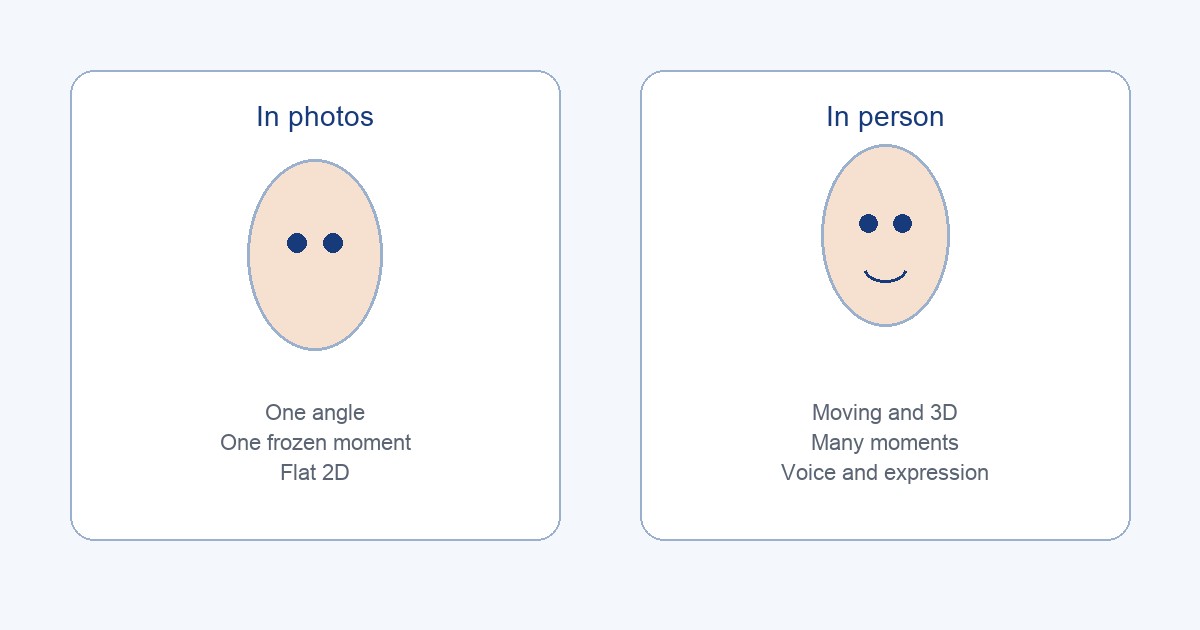
So if you've ever looked at a picture of yourself and thought, "That's not me," you may be right. Here's why the camera and real life so often disagree.
Photogenic vs attractive: two different tests
A photo judges your face in one frozen moment, while real life judges it over minutes or hours. Those are different jobs, and a face can be great at one and only okay at the other.
Being photogenic is about how a face works as a picture. It's the shape of your face under light, how it looks from one angle, and how relaxed you look when someone is watching. As general knowledge, faces with strong bone structure and clear contrast between light and shadow tend to photograph well. Balance plays a part too, which we cover in our guide to facial symmetry and attractiveness.
Being attractive in person takes in much more. People see how your face moves, hear your voice, notice how you listen, and react to your energy. First impressions also spill over into what people assume about you, a pattern explained in our article on the halo effect and attractiveness. None of that fits inside a single still frame.
That's why the two can split. Some people look striking in photos and ordinary across a table. Others are the reverse.
A photo freezes a face that's made to move
Faces are meant to be seen in motion, and a still photo removes the motion. Research backs this up: people judge moving faces and still photos of faces by different standards, and the emotion a face shows seems to count for more when it's moving (Rubenstein, 2005).
Think about what that means in daily life. A warm smile that builds slowly, eyes that light up when you laugh, the way your face changes when you're interested in someone: all of that is part of why people find you attractive. A camera catches one slice of it, often a slice you didn't choose.
It also explains the mid-sentence photo, the one where your mouth is half open and your eyes are half shut. In person, nobody noticed that moment. It lasted a fraction of a second. The camera kept it forever.
You've spent years looking at a flipped version of yourself
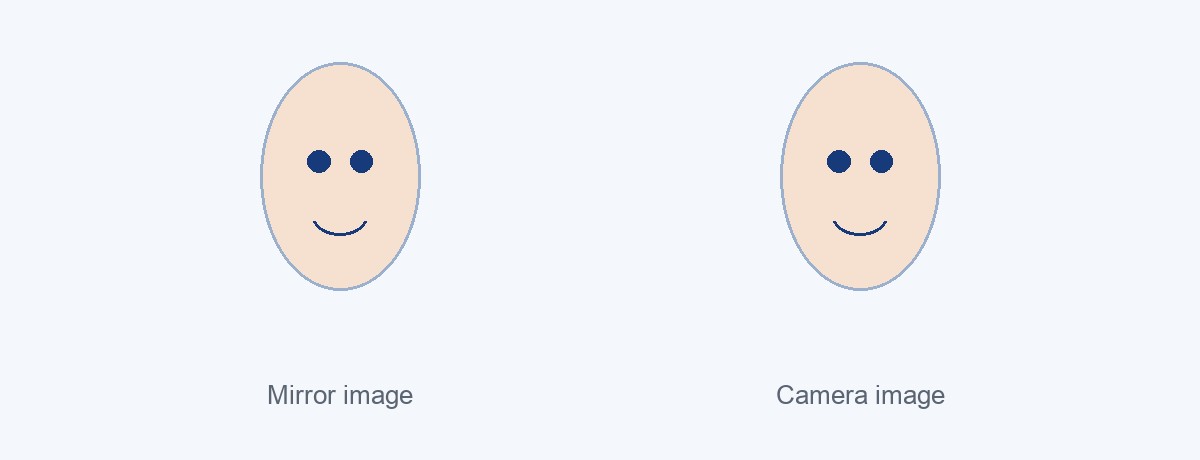
The face you know best is the one in your mirror, and that face is reversed. In a classic study, women preferred a mirror-image print of their own photo, while their friends and partners preferred the true, unflipped print (Mita, Dermer & Knight, 1977). The researchers linked this to mere exposure: we tend to like what we see most often.
So when a normal photo looks slightly off to you, with your part on the wrong side or your smile tilted the wrong way, that feeling may come from habit, not from the photo being bad. Your friends see your true face every day. To them, the photo probably looks just like you.
Want a quick check? Flip a photo of yourself in your phone's editor. If the flipped version suddenly looks better to you, you've just seen this effect in action.
Camera distance quietly changes your face
A phone held close to your face changes its shape. People notice, even if they can't say why. In one set of studies, face photos taken from inside personal space got lower ratings for trustworthiness, competence and attractiveness than photos of the same faces taken from further away (Bryan, Perona & Adolphs, 2012). This held even when image size, expression and lighting were kept the same.
Another study used a math model of selfies and found that close-range shots make the nose look bigger, and the closer the camera, the bigger it looks (Ward et al., 2018). That's why an arm's-length selfie can look so different from a photo a friend takes from across the room.
Light adds its own changes. As general knowledge, soft light from a window is kind to most faces, while a ceiling bulb casts shadows under the eyes and a phone flash flattens everything. None of this is about your actual face. It's about where the camera and the light happen to be.

One photo is a lottery ticket
Any single photo of you is a random pick from thousands of possible ones, and the spread between them is huge. When researchers collected many everyday photos of the same people, attractiveness varied more between photos of one person than it did between different people (Jenkins et al., 2011).
Your best and worst photos can be further apart than you and a total stranger. If you judge your looks from one unlucky picture, you're mostly judging the picture.
It's also why rating scales can feel so random. The same face can get a 5 from one photo and an 8 from another, which we break down in our guide to the 1-10 attractiveness scale.
Your memory of your own face isn't neutral
Part of feeling "not photogenic" may come from your memory, not the camera. In a study actually titled "Why am I not photogenic?", students picked versions of their own photos with slightly bigger eyes and smaller mouths as the most like their real face. When they judged classmates, they picked the accurate photos (Wen & Kawabata, 2014).
People seem to remember their own face as a little more attractive than it is. Then a plain, honest photo comes along and doesn't match the picture in their head. Flipping the photos into mirror images didn't change the choices in that study, so this seems to be a separate effect from the mirror habit above.
This isn't vanity. It's a normal quirk of memory, and most people have it. It does mean your own eye is the least reliable judge of your photos.
How to tell if you're the not-photogenic type
The clearest sign is a gap: people react to you in person better than your photos suggest they should. If that sounds like you, check the list below.
None of these proves anything on its own. They're common patterns (general knowledge, not research), and the more of them fit, the more likely the camera is the problem rather than your face:
- Friends and dates say you look better in person than in your pictures.
- Candid shots look more like you than posed ones.
- Your face goes stiff the moment someone says "smile."
- Close selfies look worse to you than photos other people take.
- Your favorite photos catch you laughing, talking or mid-movement.
- Video calls and clips feel closer to the real you than still photos.
- A photo of you looks wrong to you, but your friends say it looks normal.
If most of these sound familiar, you're probably attractive but not very photogenic. The good part is that photos are easier to change than faces.
Try the two-photo test
The quickest way to see the camera's effect is to change one photo setup and keep your face the same. Here's a simple version you can do in five minutes.
First, take a close selfie at arm's length under a ceiling light, the way most of us take them. Then ask a friend to take a photo of you from a few steps back, facing a window in daylight. Keep a relaxed expression in both. Upload the two photos and compare your scores out of 10.
If the numbers differ, that difference came from the photo, not from your face changing in five minutes. Keep in mind that any score is an estimate from one image. It can't measure how photogenic you are or how people feel about you in person.
One more tip: let someone else choose which photo looks most like you. In two large online studies with 610 people, profile photos picked by strangers made better first impressions than the photos people picked of themselves (White, Sutherland & Burton, 2017). Other eyes really do choose better.