
Facial Symmetry and Attractiveness: What Science Actually Says
Yes, a more symmetrical face is usually rated as more attractive, but the effect is smaller than most people think. When researchers edit a photo so both sides match, most people pick the edited version. Yet when scientists measure real, unedited faces, symmetry often matters less than how average, or typical, a face looks.
This guide walks through what the research on facial symmetry and attractiveness really shows: the classic experiments, the newer studies that pushed back, and why a perfectly even face can look a little off.
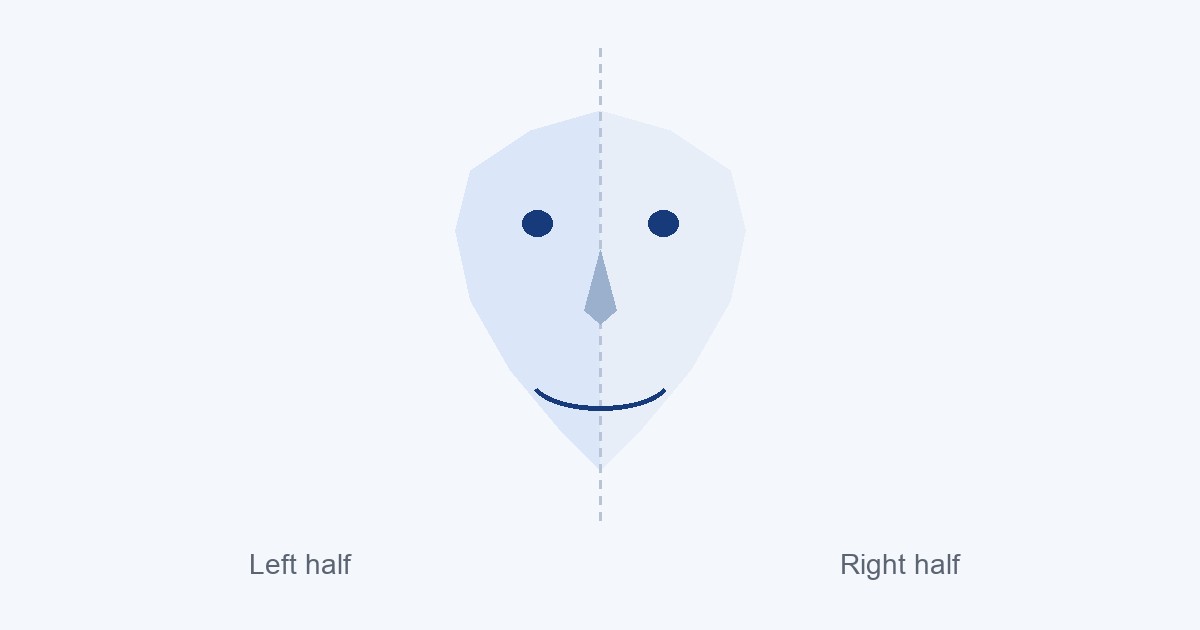
Is a symmetrical face more attractive?
Usually, yes, but only by a modest amount and not in every study. Experiments that edit the same face tend to find a clear preference for the more symmetrical version, while studies that compare many different real faces find a weaker link.
What the classic studies found
The early studies mostly found that symmetry helps. Karl Grammer and Randy Thornhill (1994) built computer images of men's and women's faces, measured how symmetrical each one was, and had people rate faces of the opposite sex. Their paper was the first to show that facial symmetry has a positive effect on attractiveness ratings.
Gillian Rhodes and her colleagues took a more direct route in 1998. They took real face photos and changed only how symmetrical they were. When they raised symmetry, attractiveness went up. When they lowered it, attractiveness went down. Natural differences in symmetry between faces also lined up with how attractive people found them, and the same pattern held when people judged the faces as possible life partners.
Not every early study agreed. John Swaddle and Innes Cuthill (1995) made faces more symmetrical and found that people rated them as less attractive. David Perrett's team (1999) argued that results like this could come from the editing itself, which can warp feature shapes and change skin texture. When they changed only the shape of the face and kept the skin texture the same, more symmetry raised attractiveness ratings for both male and female faces.
What newer studies found
Newer work still finds that people prefer an edited symmetrical face, but it questions how much symmetry matters in everyday faces. In a 2023 study from Malaysia, Harun and colleagues (PubMed) photographed 30 young adults and asked 100 people to compare each original photo with a symmetrical edit. People chose the symmetrical version in 91.2% of cases.
A 2025 study in Scientific Reports by Lee and colleagues (Nature) asked a different question. Instead of editing faces, the team measured symmetry, averageness and sex-typical shape in real face photos, then checked which of these predicted attractiveness ratings when all three were looked at together. Averageness predicted attractiveness in both men's and women's faces, and femininity predicted it in women's faces. Symmetry did not. The authors say this fits other recent studies that point the same way.
So here's the honest summary. If you take one face and make it more symmetrical, people tend to like it more. Across a crowd of real faces, though, symmetry isn't the strongest clue to who gets rated as attractive.
Why do we find symmetry attractive?
There are two main explanations. One says symmetry is a sign of good health, and the other says symmetrical, typical-looking faces are simply easier for the brain to take in. Many researchers think both play a part.
The health and good-genes idea
The idea is that a face only grows evenly on both sides if development goes smoothly. Illness, parasites or stress while growing up can leave small, random differences between the left and right side, which scientists call fluctuating asymmetry. If symmetry hints at a healthy start in life, being drawn to it could help us pick healthier partners. Grammer and Thornhill designed their 1994 study around this parasite theory.
There's some support for it. Ben Jones and colleagues (2001) found that the link between symmetry and attractiveness seemed to run through how healthy a face looked. People judged symmetrical faces as healthier, and that helped explain why they also found them more attractive.
The evidence for real health is weaker. Rhodes and colleagues (2001) found that making faces more symmetrical or more average made them look healthier. But when they checked medical records for a group of 17-year-olds, facial asymmetry wasn't linked to their actual health. A face can look healthy to us without that look being a reliable health report.
Symmetry is easy for the brain to process
The second explanation is simpler: we tend to like things that are easy to process. Symmetrical and average faces sit close to the typical face our brain has built up from every face we've seen, so they may be quicker to read and feel more pleasant.
Piotr Winkielman and colleagues (2006) tested this idea with dot patterns and simple shapes rather than faces. The more typical a pattern was, the faster people could sort it and the more attractive they rated it, and that speed explained part of the liking. Recordings of facial muscles also showed that typical patterns set off quick positive reactions.
For faces, this is still debated. Jones and colleagues said their health results were hard to explain with an ease-of-processing account alone. In her 2006 review, Gillian Rhodes argued that both forces may have shaped what we find beautiful, so it doesn't have to be one or the other.
How symmetrical is an attractive face?
There's no proven percentage that makes a face attractive. We couldn't find any study that sets one, so treat any "ideal symmetry score" you see online with caution. What researchers actually do is measure how far matching points on the two sides of a face differ, then compare that with how people rate the face.
In the Harun study, the team took standard facial measurements and turned the left-right differences into an asymmetry index, where 0% would mean perfect symmetry. None of the 30 people scored 0%, and a third of them fell between 1.6% and 2.0%. The authors suggest numbers like these can work as a guide to normal facial balance, for example before facial surgery. They don't present them as a beauty cutoff.
Other studies use different methods, such as marking many points on a photo or comparing a face with its mirror image. That means a score from one study or app can't be compared directly with a score from another. If a symmetry tool gives you a percentage, it's most useful for comparing photos of your own face taken the same way, not as a grade.
Is an asymmetrical face unattractive?
No. Some asymmetry is completely normal, and even faces picked for their beauty aren't perfectly even. Small left-right differences are part of every face, including very attractive ones.
Every face is a little uneven
In the Harun study, not one of the 30 faces was perfectly symmetrical. Researchers also split asymmetry into two kinds. Fluctuating asymmetry is the small, random differences linked to how a person developed. Directional asymmetry is a one-sided difference that shows up the same way in many people. Swaddle and Cuthill pointed out that some facial features, including ones that add to attractiveness, naturally show this directional kind.
Dahlia Zaidel and Jennifer Cohen (2005) looked at head-on photos of faces from professional modeling agencies. For each face they built two new versions, one made from two left halves and one from two right halves. If these beautiful faces were truly symmetrical, both versions would look the same. Instead, people usually saw a difference, which the authors took as a sign that very beautiful faces can still be asymmetrical.
Why perfect symmetry can look strange
A perfectly symmetrical face can look a little flat or unnatural, mostly because of how it's made. Swaddle and Cuthill suggested that removing the natural one-sided differences may make faces look unemotional, and Perrett's team later pointed to editing problems such as changed skin texture.
How the symmetrical face is built matters. If you copy one half and flip it, anything lopsided on that half gets doubled, and the face can stop looking like the real person. Rhodes and colleagues instead blended each face with its own mirror image, and people preferred those perfectly symmetrical blends to less symmetrical versions of the same faces. So perfect symmetry isn't the problem on its own. Clumsy editing often is.
Symmetry vs averageness vs femininity (comparison table)
Symmetry is only one of three face traits researchers keep coming back to. The other two are averageness, meaning how close a face is to the typical face of a group, and sexual dimorphism, meaning how feminine or masculine a face looks. Here's how they compare.
| Trait | What it means | What studies found | Key sources |
|---|---|---|---|
| Symmetry | The left and right sides of the face match | Edited symmetrical faces are usually preferred. In real faces the effect is weaker, and the 2025 study found no effect once the other traits were counted. | Rhodes 1998, Perrett 1999, Lee 2025 |
| Averageness | The face is close to the average of many faces | Blended composite faces were rated more attractive than almost all the faces used to make them. It predicted attractiveness in real male and female faces. | Langlois & Roggman 1990, Lee 2025 |
| Femininity | How feminine a woman's face shape is | Predicted attractiveness in women's faces. | Lee 2025 |
| Masculinity | How masculine a man's face shape is | Results are mixed. It did not predict attractiveness in men's faces in the 2025 study. | Rhodes 2006, Lee 2025 |
Averageness has some of the strongest early evidence. Judith Langlois and Lori Roggman (1990) blended many photos into composite faces and found that the composites got more attractive as more faces were added. Not every study agrees, though: Grammer and Thornhill's 1994 data did not support their own prediction that averageness would raise ratings.
Rhodes' 2006 review, which pooled earlier studies, concluded that averageness, symmetry and sexual dimorphism are all attractive in both male and female faces and across cultures. The 2025 results suggest that when you measure all three in the same real faces, averageness and femininity carry most of the weight.
Does symmetry matter more for men or women?
Symmetry seems to matter for both, and there's no strong evidence that it matters much more for one sex. Perrett's team found that more symmetry raised ratings for both male and female faces, and Rhodes' 2006 review found symmetry attractive in both.
Where men and women differ is in the other traits. In the 2025 study, a more feminine face shape made women's faces more attractive, but a more masculine shape didn't do the same for men. There's also a small twist from Jones and colleagues: when people judged how healthy a face looked, they were more sensitive to symmetry in faces of the opposite sex.